Home |
Games |
About |
News |
Forum |
|
|||||||
The Realm of Hy Brasil |
|||||||
 |
|||||||
The Aes Sidhe Theme |
|||||||
Download PDF
Lords of Hy Brasil — The World We Are Building
A Living Campaign of War, Diplomacy, Trade, Myth, and Divine Power
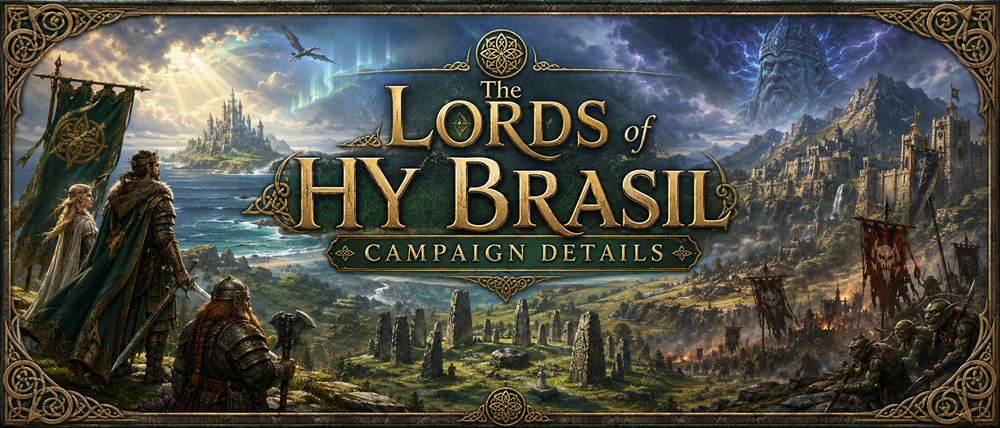
Lords of Hy Brasil is being designed as a long-form Celtic-inspired grand strategy game where players take command of ancient noble houses competing for power across the lost island realm of Hy Brasil.
This is not intended to be a quick battle game or a short match-based strategy title. Lords of Hy Brasil is a persistent campaign world where players build realms, raise armies, forge alliances, negotiate trade, honour or betray treaties, worship ancient gods, and attempt to shape the fate of the island across many turns.
Each campaign world will become its own unfolding legend. Castles will rise and fall. Ancient houses will form alliances. Trade routes will strengthen kingdoms. Armies will march across the land. Gods will be honoured, angered, or ignored. Wars may begin with a border dispute, a broken promise, a stolen shipment, or a claim to kingship.
At the heart of the game is one question:
Can you lead your house from survival to sovereignty — and perhaps claim the crown of Hy Brasil itself?
The Grand Campaign
Official campaign worlds in Lords of Hy Brasil are planned as long-form multiplayer campaigns where each player controls a realm, house, lordship, or faction within the island.
Players will submit orders, manage resources, build strength, negotiate with other rulers, and attempt to outlast or overcome rival powers. Campaigns may last months or even years, depending on the players, world size, victory conditions, and balance of power.
The planned game model is:
Free client
Free tutorial / training world
Paid Grand Campaign Pass for official long-form campaign worlds
The free training realm will introduce new players to the core systems: castles, armies, resources, movement, trade, diplomacy, and battle reports. Official Grand Campaign worlds will be the serious long-form games where player diplomacy, military planning, and world politics truly matter.
A Grand Campaign is intended to feel like an old campaign chronicle: a history written by the actions of its players.
Castles, Realms, and Power
Every player begins as a ruler with lands to protect and ambitions to fulfil. Castles are the foundation of power in Hy Brasil.
Castles may act as centres of:
Population
Resource storage
Army recruitment
Food production
Weapon and armour production
Markets
Defence
Political control
Religious devotion
A well-defended castle can protect a kingdom. A poorly supplied castle can become a trap. A castle with a market may become wealthy. A castle with strong armouries may supply armies across the realm. A castle near sacred land may become politically or spiritually important.
Players must decide what kind of power they want to build. A realm may become rich through trade, feared through war, respected through alliances, or blessed through devotion to the gods.
Armies and Warfare
War in Lords of Hy Brasil is planned around preparation, logistics, numbers, equipment, morale, and strategic decisions.
Players will raise armies from different peoples and forces, including humans, orcs, goblins, elves, dwarves, and other possible cultures or races as development expands. Each people may have different strengths, weaknesses, movement values, carrying ability, combat traits, and reproduction or recruitment rates.
Armies will not simply be numbers on a screen. They will require support.
A ruler who has 2,000 warriors but only 1,000 weapons is not truly fielding a fully armed force. A ruler who has enough armour for only half their soldiers may suffer in battle. A ruler with better preparation, better equipment, and stronger supply may defeat a larger but poorly equipped enemy.
The planned battle systems include:
Troop numbers
Race/unit strengths
Weapons
Armour
Battle penalties for under-equipped forces
Castle defence
Casualties
Battle reports
Victory and defeat records
The aim is to make battles understandable but meaningful. Players should be able to see why they won or lost, and they should have chances to prepare better next time.
Weapons, Armour, and the Armoury
Weapons and armour are planned as major strategic resources.
Castles with armoury structures may produce equipment for armies. These supplies can then be used to strengthen troops, support allies, or trade through the Guild of Merchants.
For example, a lord may have:
In that case, every warrior may have a weapon, but not every warrior is properly armoured. This could create a battle penalty.
If that same lord had:
then every warrior could potentially have a much higher armour rating, up to the maximum allowed by the game system.
This creates a deeper layer of military planning. It is not enough to raise men. A wise ruler must arm them, protect them, feed them, and send them into battle only when the time is right.
Resources and Production
The economy of Hy Brasil will support the military and political game.
Players may gather or produce resources such as:
Resources will matter for building, recruiting, equipping armies, supporting castles, trading with other players, and surviving long campaigns.
A wealthy realm may not always have the strongest army, but it may have the power to buy allies, hire support, stockpile armour, or survive a long war. A poor realm may be forced into dangerous alliances, raids, or desperate expansion.
Diplomacy
Diplomacy is planned as one of the central pillars of Lords of Hy Brasil.
Players will be able to communicate, bargain, threaten, negotiate, form alliances, recognise rulers, arrange trade, offer tribute, demand land, and betray each other.
A ruler may say:
“Recognise me as High King and I will not invade your coast.”
Another may answer:
“Withdraw your army from the pass and I will send you 1,000 swords before winter.”
The game is designed so that words can matter as much as armies. A small realm may survive by clever diplomacy. A mighty empire may collapse if all its neighbours unite against it. An alliance may dominate the island — until ambition tears it apart.
Diplomacy may include:
Peace treaties
Alliances
Trade agreements
Recognition of kingship
Threats and ultimatums
Tribute demands
Neutrality agreements
Joint invasions
Secret bargains
Betrayal
The goal is to create a game where players remember not only battles, but the political stories behind them.
The Lords of Hy Brasil Campaign Forum
The Campaign Forum is planned as the living political heart of the game.
While the game client will handle the map, orders, castles, armies, turns, and reports, the website forum is planned to become the place where the world speaks.
Each official campaign world may eventually have its own dedicated forum area where players can continue diplomacy between turns.
Planned forum areas may include:
Public Diplomacy
Trade and Bargaining
War Declarations
Alliance Halls
World Chronicles
Player Discussion
Rules and Help
Campaign Announcements
The forum will allow players to make royal statements, accuse rivals, announce alliances, negotiate trade, record treaties, threaten enemies, and celebrate victories.
A campaign forum might contain posts like:
“The House of Dul Dana declares the northern pass closed to all armed forces.”
“The Emerald Pact recognises Lord Arakonir as rightful protector of the western shore.”
“House Maelthorn offers 2,000 wood in exchange for 500 iron. Guild delivery preferred.”
“Let it be known that any lord trading with our enemies will be treated as an enemy.”
This gives every campaign a public memory. The forum becomes the record of its politics, wars, insults, bargains, and betrayals.
The Guild of Merchants
The Guild of Merchants is planned as a neutral NPC trade faction that helps players trade across long distances.
In a game as large as Lords of Hy Brasil, trade should be useful, but it should not become so slow that players avoid it. If every trade required a lord or caravan to physically travel across the map, many deals would take too long to be practical.
The Guild of Merchants solves this problem in a way that fits the world.
In the lore, the Guild is an ancient neutral order of merchant houses protected by old treaties, sacred laws, and domesticated dragons. Their dragon-caravans can move goods quickly between recognised markets, allowing distant players to trade without waiting many turns for manual transport.
In game terms, the Guild allows players to make fast, safe, paid trade deliveries between castles with markets.
A typical Guild trade might work like this:
Player 3 buys 2,000 swords from Player 76.
The buyer has enough gold.
The seller has enough swords.
Both castles have markets.
At the end of the turn, the Guild completes the delivery.
The seller receives payment.
The buyer receives the swords.
The Guild takes a fee.
The Guild is not intended to remove local trade. Instead, it creates a choice:
Guild Trade:
Fast, safe, long-distance, but costs a fee and requires markets.
Local Trade:
Slower, cheaper, physical, and potentially more strategic or risky.
This gives markets a powerful role in the game. A castle with a market becomes part of the island-wide trade network. A castle without a market must rely on local movement, caravans, armies, or nearby allies.
The Guild itself is planned as non-attackable in the early version. It exists as a neutral world institution, allowing trade to function smoothly while adding flavour to the setting.
Markets
Markets are planned as important castle structures.
A castle with a market may be able to:
Use the Guild of Merchants
Send and receive long-distance trade
Sell surplus goods
Buy weapons, armour, resources, or supplies from other players
Support diplomacy through trade
Become economically important
This means players may choose to build military castles, production castles, defensive castles, or market castles depending on strategy.
A realm with several markets may become rich and politically influential. A realm without markets may be more isolated, especially during war.
Local Trade and Physical Movement
Not all trade will need to go through the Guild.
Players may still use local trade where goods are moved physically by lords, armies, caravans, or other transport systems. This can be slower but cheaper, and it may allow players to move goods without paying Guild fees.
Local trade also creates strategic risk. A caravan might travel near enemy land. An army carrying supplies may be delayed. A lord sent to trade may be needed elsewhere. These decisions create meaningful logistics without forcing every trade to be slow.
The intended design is:
Use the Guild for fast, safe trade. Use local transport when you want to save money, avoid markets, or control the movement yourself.
Religion and the Gods of Hy Brasil
The world of Hy Brasil is not only political and military. It is also spiritual.
The website will include lore pages about the gods, goddesses, demi-gods, and darker powers connected to the setting. These divine figures are planned as part of the world identity, giving players a deeper sense of culture, belief, duty, and myth.
The gods may not simply be background decoration. They can help define the values of different peoples, houses, temples, sacred lands, and factions.
A player’s house may honour one god above others. A castle may become known for a particular cult or shrine. A ruler may claim divine favour. A war may be justified as sacred duty. A faction may rise under the banner of a deity.
The gods of the website and lore may include figures such as:
Some may represent life, nature, wisdom, fertility, craft, light, sovereignty, or the land itself. Others may represent domination, corruption, fire, tyranny, sacrifice, or false divinity.
The divine lore gives the world moral and mythic tension.
The Mother Goddess
The Mother Goddess represents life, creation, protection, fertility, the land, ancestry, and the deep source of nature.
Followers of the Mother Goddess may value:
Protection of the land
Growth of population
Honour to ancestors
Sacred groves
Balance between people and nature
Care for children, families, and clans
Resistance against corruption
A house devoted to the Mother Goddess may see itself as guardian of the living world. It may oppose reckless destruction, famine, cruelty, and the abuse of sacred places.
Such followers may not always be peaceful, however. If the land is threatened, they may fight with fierce purpose.
Cernunnos
Cernunnos is the horned god of the wild, forests, beasts, hidden paths, instinct, strength, and the untamed places beyond civilisation.
Followers of Cernunnos may value:
Freedom
The wild lands
Hunting
Animal spirits
Survival
Strength through nature
Sacred forests
Independence from tyrants
A ruler who honours Cernunnos may favour scouts, hunters, forest strongholds, ambush tactics, and a fierce refusal to be ruled by others.
Cernunnos is not simply a gentle nature spirit. He is the deep wild. He teaches that civilisation is fragile, and that those who forget the old ways may be consumed by them.
Belenus
Belenus is a god of light, healing, the sun, fire, vision, renewal, and sacred authority.
Followers of Belenus may value:
Truth
Healing
Solar rites
Fire festivals
Noble leadership
Courage
Purification
Protection against darkness
A house devoted to Belenus may claim to bring order, justice, and light to the island. They may build temples, hold festivals, and present their wars as campaigns against darkness or corruption.
But light can also become arrogance. Some rulers may use the name of Belenus to justify conquest.
Etain
Etain is associated with beauty, transformation, sovereignty, love, rebirth, grace, and otherworldly mystery.
Followers of Etain may value:
Diplomacy
Beauty
Royal legitimacy
Transformation
Marriage alliances
Courtly influence
Poetry and story
Mystical rebirth
A house devoted to Etain may be skilled in diplomacy, political marriages, influence, negotiation, and the symbolic power of queenship or kingship.
Etain represents the idea that power is not always taken by the sword. Sometimes it is won through grace, legitimacy, desire, and destiny.
Brigid
Brigid is a goddess of fire, poetry, healing, smithcraft, inspiration, wisdom, and sacred creation.
Followers of Brigid may value:
Craftsmanship
Smithing
Healing
Poetry
Learning
Sacred fire
Armouries
Invention
The protection of knowledge
Brigid fits especially well with the game’s weapon and armour systems. A castle devoted to Brigid might be known for its forge, healers, poets, or wise women.
Her followers may believe that creation is sacred, whether it is a poem, a sword, a shield, a treaty, or a kingdom.
Gaia
Gaia represents the living earth, deep nature, balance, mountains, rivers, soil, harvest, and the world beneath all kingdoms.
Followers of Gaia may value:
Earth wisdom
Agriculture
Balance
Sacred rivers
Mountains and stones
Fertility of the land
Natural law
The long memory of the world
A house devoted to Gaia may be rooted, patient, defensive, and difficult to destroy. They may see themselves as servants of the land rather than owners of it.
Gaia reminds players that kingdoms rise and fall, but the earth remembers.
Yaldabaoth
Yaldabaoth is planned as a darker demi-god figure associated with false divinity, pride, domination, illusion, control, and corrupted authority.
Followers of Yaldabaoth may value:
Power over others
Secret knowledge
Control
Hierarchy
False light
Manipulation
Spiritual pride
Hidden rule
Yaldabaoth may represent the ruler who believes himself divine, the priest who uses faith as a chain, or the empire that mistakes control for order.
In the lore, followers of Yaldabaoth may be dangerous not because they look obviously evil, but because they claim to bring truth while hiding domination beneath it.
Moloch
Moloch is planned as an infernal demi-god of tyranny, sacrifice, cruelty, devouring power, domination, and the machinery of oppression.
Followers of Moloch may value:
Fear
Sacrifice
Brutal authority
War without mercy
Enslavement
Obedience
Fire and blood
Power at any cost
Moloch represents the worst form of rule: the kingdom that feeds upon its own people, the ruler who demands everything, the war machine that consumes the innocent.
In the world of Hy Brasil, cults or factions influenced by Moloch may become enemies of freedom, balance, and the living earth.
Faith, Factions, and Player Identity
Religion in Lords of Hy Brasil can become part of player identity.
A player might style their house as:
Guardians of the Mother Goddess
Hunters of Cernunnos
Children of Belenus
Court of Etain
Forge-Kin of Brigid
Stonebound of Gaia
Servants of Yaldabaoth
Cult of Moloch
These identities may be used for roleplay, forum diplomacy, faction culture, banners, heraldry, temple lore, and future game systems.
A player may declare:
“We march under the light of Belenus.”
Another may answer:
“The forests belong to Cernunnos. Enter them and be lost.”
This kind of mythic identity gives the campaign world more atmosphere and makes diplomacy more colourful.
Campaign Reports and World History
At the end of each processed turn, players will receive reports showing what happened.
Reports may include:
Resource production
Army movement
Trade results
Guild deliveries
Battles
Casualties
Castle changes
New alliances
Broken treaties
World events
Religious events
Victory score changes
The long-term goal is for campaign reports and forum chronicles to create a living record of each world.
Players should be able to look back and say:
“That was the turn the northern alliance betrayed us.”
“That was when the Guild delivered the swords that saved Castle Dun Aed.”
“That was the battle that broke the western kingdom.”
This is what makes a long campaign memorable.
Victory and Endgame
Victory in Lords of Hy Brasil may come through different paths depending on campaign rules.
Possible victory routes may include:
Conquest
Alliance dominance
Control of key castles
Recognition as High King
Sacred site control
Economic supremacy
Final Victory Score
Faction victory
Survival to campaign end
A campaign may have a maximum real-world length. If no single ruler, faction, or alliance wins by direct victory before that limit, the winner may be decided by final campaign score.
Victory Score could include:
Territory
Castles
Population
Military power
Wealth
Sacred sites
Alliances
Titles
Trade power
Campaign achievements
This prevents campaigns from dragging forever while still allowing long-form play.
The Finished Vision
The finished vision for Lords of Hy Brasil is a game where the client, server, website, forum, lore, and campaign systems all work together.
The Game Client
Used for orders, castles, armies, resources, movement, battles, trade, and reports.
The Server
Stores the world, validates orders, processes turns, resolves battles, handles trades, and keeps the campaign fair.
The Website
Shows game information, lore, news, artwork, gods, campaign pages, and community updates.
The Campaign Forum
Lets players negotiate, threaten, trade, declare war, form alliances, record history, and continue diplomacy between turns.
Together, these systems are intended to create a living strategy experience: part grand strategy game, part diplomacy simulator, part mythic campaign chronicle.
Placeholder Page Closing Text
Lords of Hy Brasil is currently in development. The systems described on this page represent the planned direction for the finished game and website experience.
The goal is to build a world where players do more than fight battles. They will build kingdoms, honour gods, arm warriors, trade through dragon-backed merchant guilds, negotiate alliances, betray rivals, write public proclamations, and shape the history of Hy Brasil one turn at a time.
In this world, armies may win battles, merchants may save kingdoms, gods may inspire followers, and words may begin wars.
Enter the mist. Raise your banner. Choose your god. Claim your place in the legend of Hy Brasil.