Home |
Games |
About |
News |
Forum |
The Realm of Hy Brasil |
|
The Lords Theme |
How To Play |
Campaign Forum |
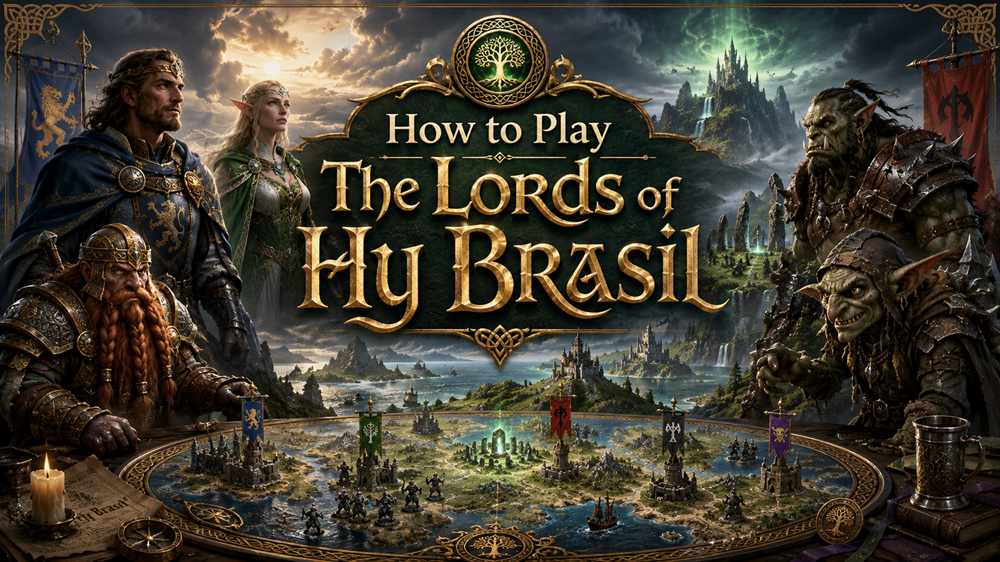
How to Play The Lords of Hy Brasil
Enter the Living World of Hy Brasil
The Lords of Hy Brasil is an asynchronous multiplayer strategy, role-playing, ancient war and life simulation set in the mystical island realm of Hy Brasil — a land of castles, forests, sacred groves, rival kingdoms, old gods, sea roads, merchant guilds, warlords, priests, kings and legends.
You are not merely moving pieces across a board. You are the ruler of a living realm.
You may become a noble king, a feared conqueror, a wealthy merchant lord, a religious leader, a ruthless tyrant, a protector of the weak, a sea-raider, a High Priest, a master diplomat, a warlord of the old races, or one of the great powers who shapes the final destiny of Hy Brasil.
The game is designed to create player-driven stories. Alliances will rise and fall. Kings will be recognised and betrayed. Gods will be worshipped, invoked, and fought over. Armies will march across land and sail across misty seas. Castles will grow into centres of power. Old friends may become enemies, and defeated rivals may become loyal vassals.
A campaign world may last for months or even years, but every campaign has a final destiny: the struggle to decide who, if anyone, can unite Hy Brasil beneath the title of High King.
1. The Core Fantasy
In The Lords of Hy Brasil, you take on the role of a fantasy ruler in an ancient Celtic-inspired world of war, faith, trade and politics.
You begin with a small realm, a home castle, a chosen god, a chosen race from one of the five races of Hy Brasil, a starting population, resources, troops, and four important Lords. From there, you decide what kind of ruler you will become.
You may seek power through:
War — raise armies, equip warriors, conquer castles, defeat rival Lords and defend your borders.
Diplomacy — form alliances, send messages, negotiate peace, demand tribute, recognise kings, betray enemies and build political blocs.
Religion — follow one of the gods, build temples, gain divine favour, support High Priest candidates and take part in holy wars.
Trade — use markets, resources, weapons, armour, food, ships and the Guild of Merchants to grow rich and powerful.
Kingship — convince other players to recognise you as King, gather a kingdom around you, and perhaps one day stand as a candidate for High King of Hy Brasil.
Survival — not every player needs to conquer the world. Some may thrive as loyal vassals, merchant princes, religious guardians, military allies, neutral traders or regional powers.
The heart of the game is choice. Hy Brasil does not tell you what kind of ruler to be. It gives you a world, a people, a faith, a castle, and a chance to create your own legend.
2. Three-Day Turns
The game is played through three-day turns.
This means players do not need to be online at the same time. During each turn, you log in when you can, review your realm, issue orders, send messages, arrange trades, move armies, build structures, vote, pray, plot and prepare.
At the end of the three-day turn window, the server processes the world.
When the next turn begins, you receive reports showing what happened:
- resources produced
- food consumed
- population growth
- buildings completed
- troops trained
- armies moved
- battles fought
- trades completed
- divine powers used
- messages received
- alliances changed
- kings recognised
- High Priest elections updated
- naval movement and sea battles resolved
This gives the game the feeling of a fantasy war council. You make decisions, then wait to see how the world responds.
3. Starting the Game
At the beginning of a campaign, you create your realm and choose your first rulers.
You begin with four Lords:
- Your main Lord
- Three additional starting Lords
For each Lord, you choose important identity details such as:
- name
- sex
- class
- race
- religious allegiance
Your Lords are not just anonymous army markers. They are characters in the world. They command troops, govern castles, lead armies, take part in battles, support diplomacy, serve gods, and help define your realm’s story.
A realm led by warrior Lords may become a military power. A realm led by priests may become religiously influential. A realm led by scouts, thieves and assassins may become dangerous through information, disruption and covert action. A realm led by merchants and diplomats may become rich and politically powerful without constant warfare.
4. Choosing Your Race
Hy Brasil is home to five great races. Each race has its own identity, strengths, weaknesses and role in the world.
Humans
Humans are balanced, ambitious and adaptable. They are capable soldiers, builders, traders, diplomats and rulers. Human realms may not dominate every specialised field, but they can survive through flexibility.
Orcs
Orcs are strong, fierce and respected for their courage in war. They are dangerous in battle and can become terrifying when united under a powerful warlord. Orc realms are well suited to aggressive expansion and military strength.
Goblins
Goblins are numerous, clever and often underestimated. They can thrive in difficult lands and may be useful for raiding, scouting, trade, survival and mass armies. A Goblin realm may look weak until it is everywhere.
Elves
Elves are ancient, skilled and deeply connected to magic, memory and hidden places. They may have lower population growth but can excel through precision, wisdom, scouting, archery, diplomacy or magical influence.
Dwarves
Dwarves are strong defenders, miners, builders and armourers. They are well suited to mountains, fortifications, strongholds, siege defence and heavily equipped armies. Dwarven realms may be hard to break once established.
5. Lords, Classes and Command
Your Lords are central to the game.
Different Lord classes may be better at different things:
Fighter Lords command large armies and lead warriors in battle.
Priests and Priestesses serve the gods, bless armies, support temples and may become powerful religious figures.
Mages influence battles through magic, fear, storms, shields, summons or destructive spells.
Scouts improve movement, vision, exploration and information.
Thieves and Assassins may disrupt enemies, steal, sabotage or carry out covert missions in later versions of the game.
Each Lord has a command capacity. This represents how many troops they can effectively command. A huge army with too few Lords may suffer penalties because it is difficult to organise.
Multiple Lords can stand in the same map tile, defend the same castle, join the same battle or combine their command strength. This allows great battles involving several Lords, allied armies and large political coalitions.
6. Castles and Realms
Your castle is the heart of your power.
A castle may contain:
- population
- troops
- stored resources
- buildings
- temples
- markets
- armouries
- walls
- trained units
- Lords
- ships if coastal
- food stores
- weapons and armour
Castles produce resources, train troops, defend territory, support trade, house temples, store armies and allow your realm to grow.
As you conquer or acquire more castles, your power expands. You may also create additional Lords if your realm grows large enough. A player who controls many castles may choose to create more Lords and spread power across the map, while another ruler may prefer fewer Lords commanding larger armies.
7. Resources and Economy
A realm needs resources to survive.
Core resources include:
- gold
- food
- wood
- stone
- iron
- weapons
- armour
Food feeds population and armies. Wood supports buildings, ships, tools and trade. Stone strengthens castles and temples. Iron is used to create weapons and armour. Gold supports trade, wages, diplomacy and market activity.
Weapons and armour matter. A large army without enough weapons may fight poorly. A wealthy, well-equipped army with good armour may survive battles that would destroy a weaker force.
The economy is not separate from war. It fuels war.
8. Weapons and Armour
Armies fight better when properly equipped.
Every soldier ideally needs a weapon. If your army has fewer weapons than troops, its attack power may suffer.
Armour works as a protective rating. A small amount of armour may provide basic protection, but a fully equipped army may reach higher armour ratings and become much harder to defeat.
This means preparation matters. A poorly equipped horde may have numbers, but a smaller professional army with weapons, armour, good command and divine blessings may win the field.
9. Population and Reproduction
Castles grow population over time.
Each race may have a different reproduction rate. For example, Goblins may reproduce quickly, Humans at a balanced rate, while Elves may grow more slowly.
Population growth can be affected by:
- food supply
- safety
- buildings
- temples
- divine boons
- curses
- plague
- war damage
- overcrowding
- starvation
Population is the foundation of your army and economy. A ruler who wastes their people in endless wars may find their castles weakened. A ruler who protects and grows their population may become powerful over time.
10. The Map and Land Ownership
The map of Hy Brasil is not just a background image. Each map tile represents real land or sea.
A tile may contain:
- terrain
- owner
- castle
- fort
- city
- harbour
- resources
- armies
- Lords
- allied forces
- enemy forces
- supply capacity
- movement penalties
- defence bonuses
Tiles can be unclaimed, owned, contested, occupied, neutral, allied, vassal-controlled or part of a wider kingdom.
Land can be conquered, defended, traded, granted, demanded or used in diplomacy.
A player might say:
“Recognise me as King, and I will grant you the eastern forest lands.”
This makes territory politically meaningful.
11. Realm Borders and Kingdom Borders
The map should allow players to understand the political shape of the world.
Your own realm can be highlighted so you can clearly see your lands and borders.
Later map overlays may show:
- your realm borders
- rival realm borders
- kingdom borders
- allied territory
- enemy territory
- religious influence
- trade routes
- known armies
- naval zones
- discovered and undiscovered lands
Realm borders show individual player territory.
Kingdom borders show the larger political blocs formed when several players recognise the same King.
This means the map will not only show geography. It will show power.
12. Terrain and Supply
Different terrain affects movement, resources, supply and battle.
Plains may support more troops and produce food. Forests may produce wood and support ambushes. Mountains may provide stone, iron and strong defence. Swamps may slow armies and favour Goblins. Castles and forts provide strong defensive positions.
Each tile may also have a supply capacity. This represents how many troops the land can comfortably support.
If too many troops gather in one place, they may suffer:
- food shortage
- morale loss
- disease risk
- movement delay
- lower battle efficiency
- starvation if food runs out
This prevents players from stacking unlimited armies in one tile without consequences.
13. Movement and Armies
Armies move across the map according to terrain, roads, supply, Lords and movement rules.
An army may move faster across plains or roads, slower through forests and swamps, and with difficulty through mountains. Scouts may improve movement and information. Enemy armies may block routes, ambush forces or force battles.
When enemy forces occupy the same tile, battle may occur.
If allied armies are present on the same tile, they may fight together.
This allows large wars involving multiple players, not just simple one-player-versus-one-player battles.
14. Land Battles
Battles are resolved by comparing the strength of the forces involved.
Battle strength may include:
- troop numbers
- race composition
- attack power
- defence power
- weapons
- armour
- morale
- Lord command capacity
- terrain bonuses
- castle or fort defence
- allied support
- mage powers
- priestly blessings
- divine boons or curses
A battle report tells players what happened, who won, what casualties were taken, and what consequences followed.
The aim is not only to decide a winner, but to create stories players remember.
15. Sea Movement and Naval Warfare
Hy Brasil is an island realm, and the sea matters.
The campaign maps are intended to include:
- sea hexes
- coastal hexes
- islands
- harbours
- straits
- sea lanes
- dangerous waters
- coastal castles
- naval invasion routes
Land armies cannot normally cross sea hexes unless they are embarked on ships.
Ships allow Lords and armies to move across water, invade islands, defend coasts, transport goods, raid enemy shores and take part in naval battles.
16. Ships and Boat Building
Wood becomes an important naval resource.
A basic rule may allow coastal castles or harbours to build ships if they have enough wood. Larger or more advanced ships may eventually require harbours, shipyards, iron, trained crews or special buildings.
Possible ship types may include:
- small boats
- basic ships
- longships
- transport ships
- warships
- merchant ships
A simple early version may begin with one basic ship type that can carry a Lord, troops and cargo.
Later versions can add specialised vessels for raiding, transport, trade and naval war.
17. Embarking and Disembarking
A Lord and army can board a ship at a valid coastal location or harbour if the ship has enough carrying capacity.
Ships may have limits for:
- troop capacity
- cargo capacity
- movement
- naval attack
- naval defence
- durability
A Lord can disembark onto a valid coast, harbour or landing point.
For balance, a Lord who disembarks may be prevented from attacking a castle until the following turn. This gives defenders time to react and prevents instant surprise castle assaults from being too powerful.
18. Naval Battles
Naval battles may occur when hostile ships or fleets meet at sea.
Naval strength may depend on:
- number of ships
- ship attack
- ship defence
- Lord bonuses
- troops onboard
- boarding strength
- weather or sea conditions
- coastal fortress support
- divine or magical effects
Possible naval battle outcomes include:
- ships damaged
- ships sunk
- cargo lost
- troops drowned
- ships captured
- cargo captured
- retreat
- surviving fleets continuing their mission
Naval warfare adds a new layer to strategy. A ruler who controls the seas can threaten coastlines, protect trade, move armies quickly and dominate island regions.
19. Harbours and Coastal Power
Coastal castles can become extremely important.
A harbour may allow:
- safe embarkation
- safe disembarkation
- ship construction
- sea trade
- naval supply
- merchant activity
- stronger coastal control
Later buildings may include:
- shipyard
- lighthouse
- coastal fortress
- naval market
- dockyard
- harbour temple
A landlocked ruler may dominate inland war, but a coastal ruler may control trade, invasion routes and sea power.
20. Trade and the Guild of Merchants
Trade is one of the major paths to power.
Players may trade:
- gold
- food
- wood
- stone
- iron
- weapons
- armour
- troops
- goods
Trade can happen through direct diplomacy or through the Guild of Merchants.
The Guild of Merchants is a neutral NPC faction that provides a public market system. In the lore of Hy Brasil, the Guild uses merchant agents, caravans, ships and domesticated dragons to move goods across the world.
The Guild cannot be attacked. It exists as the trading infrastructure of the game.
Through the Guild market, a player might list:
100 trained orcs for 2,000 gold
Another player may buy them even if the two players have not directly met.
The Guild may charge a fee, making its service safe but expensive. Direct player trade may be cheaper, but it requires trust, diplomacy and sometimes physical delivery.
21. Diplomacy
Diplomacy is one of the heart systems of Hy Brasil.
Players can send messages, negotiate deals, threaten rivals, arrange trade, ask for help, form alliances, recognise kings, support High Priests and betray one another.
Diplomacy may include:
- peace offers
- alliance requests
- trade deals
- threats
- tribute demands
- military coordination
- religious vote deals
- recognition of kingship
- secret agreements
- betrayal
A player might send:
“Recognise me as King and I will defend your castle.”
Or:
“Vote for me as High Priest of Belenus and I will bless your armies.”
Or:
“Join our kingdom now, or stand alone when the northern war begins.”
The diplomacy system allows players to create their own political drama.
22. Alliances
Players can form alliances for survival, conquest, trade, religion or politics.
An alliance may coordinate military action, share messages, support trades, defend borders or help a player become King.
In battle, allied armies on the same tile may fight together. This makes alliances more than words. They can change the outcome of wars.
Later alliance features may include alliance names, shared reports, joint wars, shared victory goals, alliance diplomacy and betrayal mechanics.
23. Recognising a King
Players may recognise another player as King.
This is one of the most important political actions in the game.
A King is not only someone who conquers land. A King is someone other players choose to recognise, fear, follow or support.
More than one King may exist at the same time. This allows several kingdoms to rise across Hy Brasil.
A player may become a recognised King if enough active realms or castles support their claim.
A kingdom can form around a recognised King. The players who recognise that King become part of that kingdom’s political bloc.
This creates kingdoms made from real player relationships.
24. Kingdoms
A kingdom is a coalition of players who recognise the same King.
A kingdom may include:
- a King or Queen
- member realms
- castles
- armies
- Lords
- shared wars
- shared enemies
- trade relationships
- religious factions
- vassals or allies
Kingdoms can help one another in war, coordinate diplomacy, defend borders, share resources and prepare for the endgame struggle.
A kingdom border overlay may eventually show the combined territory of all realms loyal to the same King.
This means Hy Brasil’s political map changes as players make decisions.
25. The High King of Hy Brasil
The greatest political title in the game is High King of Hy Brasil.
Once several recognised Kings exist and the campaign world has matured, the Kings may vote for a High King.
This vote represents the attempt to unite Hy Brasil under one supreme ruler.
Voting power may be based on kingdom strength, such as the number of active castles controlled by each kingdom. A small kingdom may still matter, but a great kingdom with many castles carries greater weight.
If one candidate gains enough support, they are declared High King.
But the game does not end immediately.
The declaration of a High King begins the final challenge.
26. The Final Challenge
When a High King is declared, rival Kings and independent realms are given a limited time to defeat or overthrow the High King.
A possible rule is:
The rival Kings have 10 turns to overthrow the High King.
Since each turn lasts three days, this creates a roughly 30-day final war.
During this time, the High King must survive, hold their coalition together and defend the High Seat of Hy Brasil.
The enemies of the High King may try to:
- capture the High King’s capital
- break the High King’s coalition
- convince kingdoms to withdraw support
- defeat the High King’s armies
- destroy the High King’s naval power
- cause religious or political collapse
If the High King survives the challenge period, the High King’s coalition wins the campaign.
27. Winning the Campaign
Hy Brasil is not designed to require every player to be destroyed before a campaign ends. That would make worlds drag on forever.
Instead, the main victory path is political and military:
- Players grow their realms.
- Alliances form.
- Kings are recognised.
- Kingdoms rise.
- Kings vote for a High King.
- The High King is declared.
- Rival powers have a final challenge period to overthrow him.
- If they fail, the High King and loyal coalition win.
This creates a clean, dramatic and fair ending.
It allows a campaign to end with a great final war, not a slow decline.
28. Other Victory Paths
The High King victory is the main campaign ending, but other prestige paths may exist.
A player may be remembered as:
- greatest conqueror
- richest merchant lord
- strongest High Priest
- most loyal vassal
- most feared warlord
- greatest naval power
- greatest kingdom founder
- most successful diplomat
- largest castle holder
- defender of the faith
- betrayer of kings
Even players who are not the final High King may become legendary.
29. Campaign Archive
When a campaign ends, the world should be archived.
The final chronicle may record:
- the High King
- the winning kingdom
- loyal realms
- rival Kings
- great battles
- largest armies
- richest realms
- strongest religions
- greatest naval battles
- most important betrayals
- final map state
- campaign duration
- major player achievements
This turns every campaign into history.
A completed world is not simply deleted. It becomes part of the legend of Hy Brasil.
30. New Players and Late Joining
A campaign world should not remain open to new players forever.
In the early turns, new players may be allowed to join freely. This is the settlement phase, when realms are still small and the world is still forming.
A good standard rule is:
New players may join freely until Turn 10.
Since turns last three days, this gives around 30 days for new players to enter the world.
After that, joining becomes more restricted.
A possible structure:
Turns 1–10: Settlement Phase
New players may join normally.
Turns 11–30: Early Kingdom Phase
New players may join only by taking over abandoned or inactive realms.
Turn 31 onward: Established Campaign
Normal joining closes. New players may only enter as approved replacement rulers.
This keeps the campaign fair and prevents brand-new players from being dropped into a mature world dominated by powerful kingdoms.
31. Inactive and Defeated Players
Long campaigns may last many months. Some players will be defeated. Others may stop playing.
If a player becomes inactive, their realm may eventually become abandoned, neutral, ruined, NPC-managed or available for a replacement player.
A player might be considered inactive if they do not log in or submit orders for several turns.
Inactive realms should not block the endgame. Victory calculations should focus on active players and active castles.
This allows the campaign to continue and eventually end cleanly even if some players leave.
32. Gods and Religion
Religion is central to Hy Brasil.
Each player chooses a god to follow. The gods are not only lore. They influence politics, diplomacy, divine favour, temples, blessings, curses, High Priest elections and holy wars.
Known gods include:
- The Mother Goddess
- Cernunnos
- Belenus
- Etain
- Gaia
- Brigid
The divine world also includes darker powers and demi-gods whose followers may seek conquest, destruction, vengeance or domination.
Your chosen god helps define your realm’s identity.
A follower of Cernunnos may be drawn to wild lands, forests, beasts and old magic. A follower of Belenus may seek honour, light and kingship. A follower of Brigid may value healing, craft, poetry and sacred flame. A follower of the Mother Goddess may protect life, fertility and the land.
Religion can unite players — or tear the world apart.
33. High Priests
Each god may have one High Priest.
Followers of that god may vote for who becomes High Priest. The High Priest gains religious authority and may use divine favour for special powers.
Possible High Priest powers include:
- bless armies
- protect castles
- curse enemies
- improve harvests
- increase morale
- heal troops
- summon sacred creatures
- strengthen temples
- declare holy wars
- punish heretics
A player may become both King and High Priest, making them extremely powerful — and extremely dangerous.
34. The Great Chronicle
The game includes an in-game lore and rules library called The Great Chronicle of Hy Brasil.
This can be accessed from the main menu and later from the in-game options menu.
The Chronicle will contain:
- history of Hy Brasil
- the five races
- the gods
- kingdom lore
- campaign rules
- naval rules
- trade rules
- buildings
- warfare
- religion
- High Kingship
- tutorial information
- world stories
The Chronicle allows new players to learn the game and returning players to remind themselves how the world works.
It also helps make Hy Brasil feel like a living mythic world rather than just a strategy map.
35. The Music Hall
The main menu also includes a Music Hall.
Players can choose what music playlist is currently playing.
Music options may include:
- fantasy composer soundtrack
- Bards of the Aes Sidhe songs
- mixed playlist
The fantasy soundtrack provides atmosphere for the world, map and campaigns. The Bards music adds lore, myth, spirituality and bardic identity to Hy Brasil.
Players may choose the soundtrack that best suits their mood while reading the Chronicle, browsing the menu or preparing for war.
36. Campaign Worlds
Hy Brasil is designed to support multiple campaign worlds.
A world might be:
- a beginner world
- a standard world
- a grand campaign world
- a roleplay-heavy world
- a naval-heavy world
- a test world
- a large 1000-player world in the future
Each world can have its own map size, player limit, rules, joining window, turn speed and campaign style.
The same client can connect to different worlds, while the server controls the true state of each world.
37. Server and Client Structure
The Unity client displays the world.
The server owns the true world state.
The client contains:
- art
- music
- UI
- icons
- animations
- map rendering
- Chronicle
- Music Hall
- player controls
The server stores:
- world map data
- player accounts
- castle ownership
- armies
- Lords
- resources
- orders
- trades
- diplomacy
- religion
- fog of war
- reports
- turn results
- campaign history
This structure makes the game fairer and allows different campaign worlds to exist without needing a separate client for each world.
38. Admin and Moderator Oversight
A future World Master Client or admin console will allow the game owner and moderators to monitor campaign worlds.
This may include tools to:
- view active worlds
- check turn status
- review player reports
- monitor suspicious trades
- investigate abuse
- pause a world if needed
- send announcements
- manage replacement players
- review abandoned realms
- watch major political events
Powerful actions such as force-processing turns, editing resources, rolling back worlds or deleting campaigns would be owner-only.
This helps keep long-running multiplayer worlds healthy and fair.
39. What Kind of Leader Will You Be?
The Lords of Hy Brasil is not only about winning battles.
It is about building power.
Will you become a warlord whose armies crush every border?
Will you become a merchant prince whose gold buys loyalty?
Will you become a High Priest whose god shapes the fate of kingdoms?
Will you become a loyal vassal who helps another player rise to the High Kingship?
Will you become a sea king whose ships rule the island coasts?
Will you betray your allies at the final hour?
Will you defend the old gods, burn rival temples, unite the kingdoms, or keep your realm free from every crown?
Every campaign is a story written by its players.
Every turn matters.
Every alliance may become history.
Every kingdom may fall.
And somewhere in the mists of Hy Brasil, the throne of the High King waits.